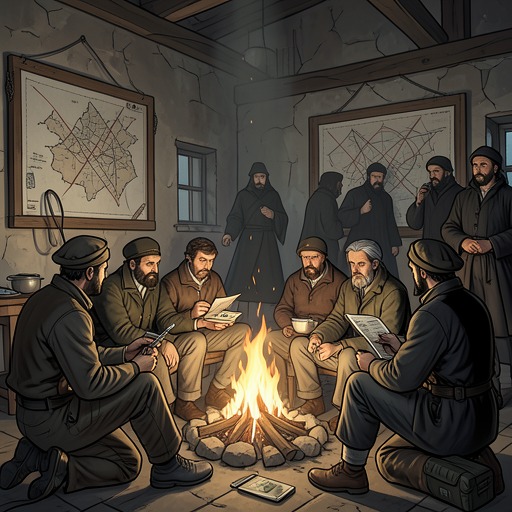
The Ballad of the Fall of Otawalle
The Deer KingThe Ballad of the Fall of Otawalle is an epic that turns the image of black wolves into a history of Otawalle’s decline. In Hohsalle’s account, the song’s opening line foreshadows a catastrophe: the wolves arrive first as objects of wonder and status, then become associated with a disease that spreads far beyond those bitten by them.
The Opening Image
When Yotalu asks Hohsalle to share what he knows about the ancient plague, Hohsalle begins by invoking the ballad. Its first line is, “Bringing black shadows from the white mountain peaks.” The “black shadows” are wolves with glistening black fur, unlike the wolves around Otawalle’s capital. The striking image gives the epic’s account of the kingdom’s decline a point of entry: creatures brought from the mountains become the focus of human fascination and, eventually, fear.
From Hunting to Trade
According to the story Hohsalle relates, noblemen went to the Toga Mountains to hunt for sport and brought back the wolves. The first animals probably did not carry the disease. Rather than being treated as a threat, they were prized for their magnificent pelts and clever faces; noblemen competed to collect them. Beast merchants and hunters then captured and sold the wolves, and historical records said that some were bred with dogs. Demand grew so much that merchants specialized in black wolves. The ballad’s ominous “shadows” thus emerge from a trade built on admiration and acquisition, not from an infection already known to its participants.
The Plague Enters the Song
One spring, a rumor spread that black-wolf merchants bitten by the animals had developed a terrible illness. They suffered high fevers and convulsions that stiffened their limbs like boards; after rashes appeared, they died within a night and a day. The Divine King of Otawalle responded by banning the black-wolf trade. For a time the disease seemed to vanish, but it returned as summer approached, now killing people who had not been bitten by wolves. In Hohsalle’s telling, the apparent disappearance is not an ending but a reversal: the danger has escaped the visible point of contact and can no longer be contained by stopping the trade alone.
Epic and Historical Explanation
Hohsalle presents the ballad as an epic account, while distinguishing its story from the historical records and medical hypotheses he recounts to Yotalu. The physicians of the Academy of Deeper Learning suspected that the disease had passed from wolves to the fleas and ticks that fed on them, then to rats. In the hot, muggy summer, it began in the capital’s poorest, most crowded districts and spread through the city; by the time authorities tried to exterminate rodents and pests, thousands had died. The ballad’s black-wolf image therefore links a remembered beginning to a much wider catastrophe, while Hohsalle’s explanation preserves uncertainty about how plagues arise and spread.